
Comparison between Mockoon and Beeceptor's API mocking services
Discover the differences between Beeceptor and Mockoon API mocking services: cloud offer, features, and more
What is Beeceptor?
Beeceptor is an online service that helps developers mock APIs. It provides a quick and user-friendly way to intercept requests and build mock API servers. Mock endpoints are deployed to the cloud and can be configured with rules and a templating language similar to Mockoon's.
Beeceptor is a paid service with a free tier that includes up to 50 requests per endpoint per day. Endpoints are public and accessible through a beeceptor.com subdomain.
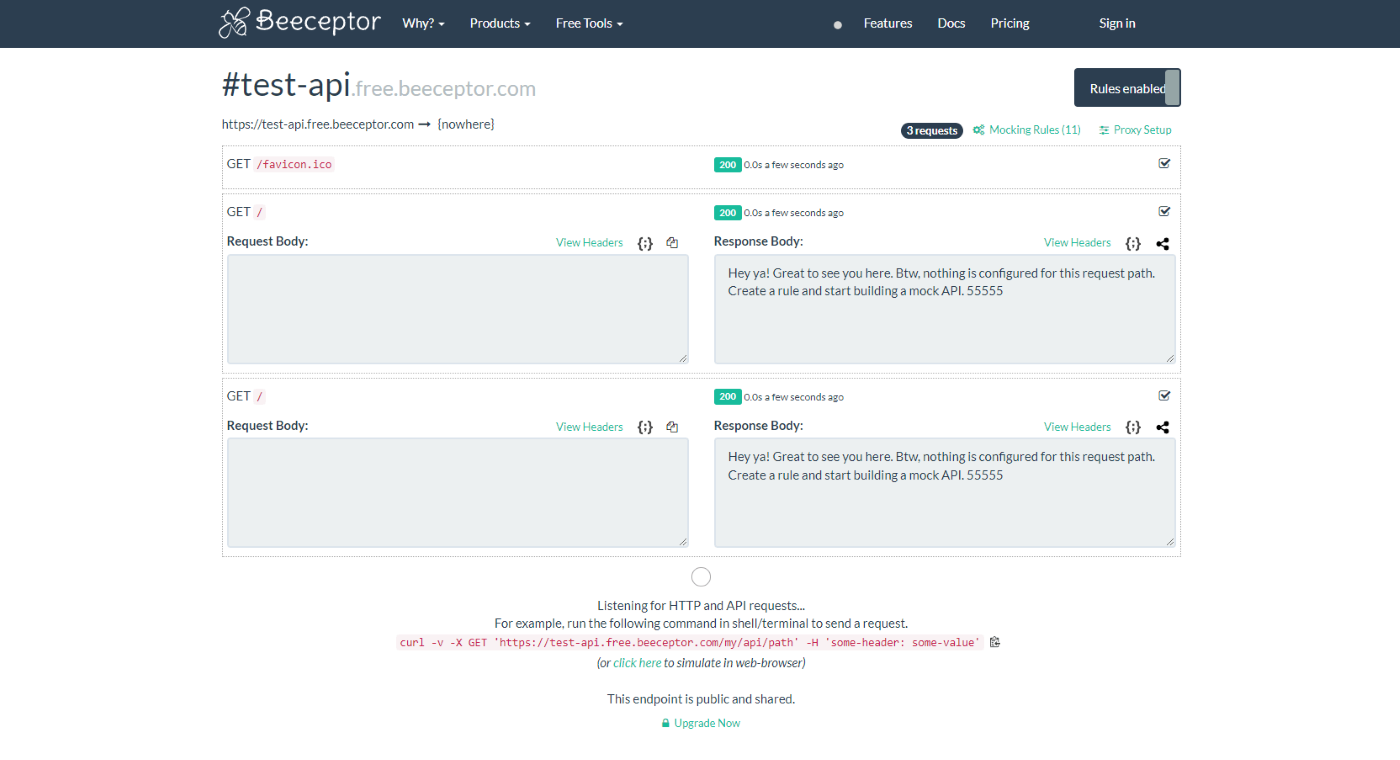 Screenshot of Beeceptor's interface
What is Mockoon?
Mockoon is a set of open-source tools that allow developers to mock APIs quickly and easily. It offers an offline-first and privacy friendly desktop application to design and run mock APIs locally. A CLI and various libraries are also available to deploy your mock APIs anywhere: CI/CD pipelines, servers, etc.
Mockoon features include a powerful templating system to generate dynamic and realistic mock data, a rules system, a proxy mode to partially mock API endpoints, and many customization options: status codes, dynamic headers, TLS, file serving, etc.
Mockoon Cloud is also available for teams and organizations looking for a cloud-based solution. It enables teams to collaborate on API mocking projects and share mock APIs with others by deploying them to the cloud.
💡 Get started with Mockoon: Download Mockoon or Discover Mockoon Cloud
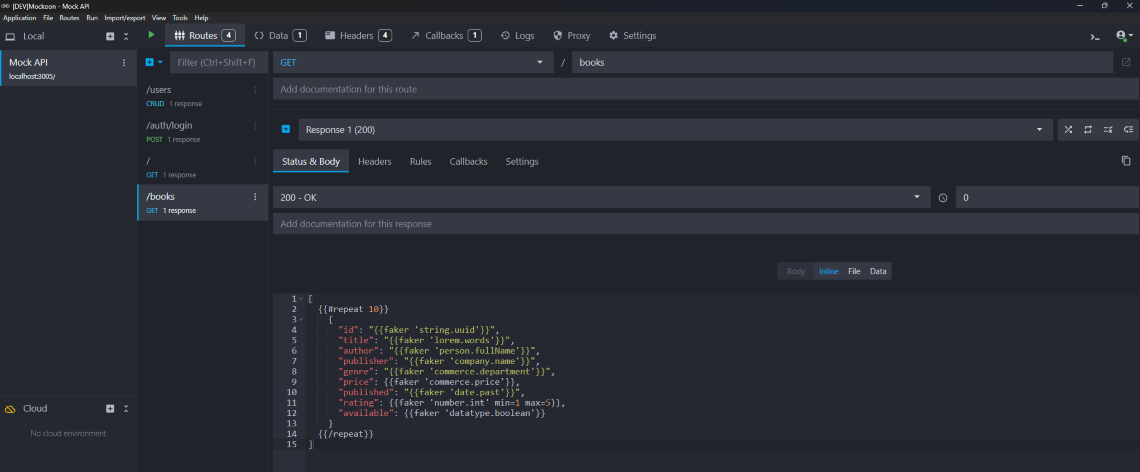 Screenshot of Mockoon's interface
Offer comparison
Below is a comparison of the main characteristics of Beeceptor and Mockoon's respective offers:
| Beeceptor | Mockoon | |
|---|---|---|
| Offline/Cloud based | Cloud only | Offline and Cloud |
| Tools provided | Online interface | Desktop application to design your mock CLI, Docker image and GitHub Action to deploy anywhere Web application for our Cloud customers |
| Free/paid | Freemium with free tier | Free for the open-source tools, paid for the Cloud |
| Billing | Billed on a per request basis | Billed per seat |
| Main cloud features | Deployment and team collaboration | Deployments, team collaboration and AI assistant |
| Open-source | ||
| Enterprise support |
Features comparison
While Beeceptor and Mockoon offer similar API mocking capabilities, they follow different approaches. Below is a comparison of their main features:
| API mocking Features | Beeceptor | Mockoon |
|---|---|---|
| Self-host | A CLI is available but only for tunneling to local services | A CLI, Docker image and GitHub Action are available to deploy in headless environments |
| Proxy mode | Can intercept and forward the traffic | Documentation |
| OpenAPI support | Supports OpenAPI specification import | Documentation |
| Recording | Mocks can be created from previously called endpoints | Mockoon can create mock endpoints based on entering requests |
| CRUD operations | Automated CRUD endpoints with fake databases | |
| Response rules | Rules can match request's path or body content | Advanced system of rules |
| Dynamic/realistic data | Templating system similar to Mockoon's one | Advanced templating system and AI assistant to generate realistic fake data |
| Callbacks/Webhooks | Callbacks system | |
| File serving | Documentation | |
| Custom headers | At endpoint's level | At endpoint's and server's levels Supports templating helpers for dynamically generated headers |
| Customizable status code | ||
| Routing patterns | Documentation | |
| GraphQL support | ||
| WebSocket support | Documentation | |
| Chaos testing | Can simulate delays, timeouts, and failure scenarios | Simulate delays and error responses to test failure handling |
| Stateful mocking | Stateful helpers for counters, key-value data, and lists | CRUD routes and data buckets for persistent state |
| JSON Schema validation | Valid JSON schema rule operator | |
| Slow network/server simulation | At endpoint's level | At server's and endpoint's levels |
For more comparisons between Mockoon and other tools, check out our other articles:
Mockoon vs Microcks, Mockoon vs Mock Service Worker, Mockoon vs Mockable, Mockoon vs MockFly, Mockoon vs MockServer, Mockoon vs Postman, Mockoon vs ReadyAPI, Mockoon vs Requestly, Mockoon vs Stoplight, Mockoon vs WireMock Cloud